English
 العربية
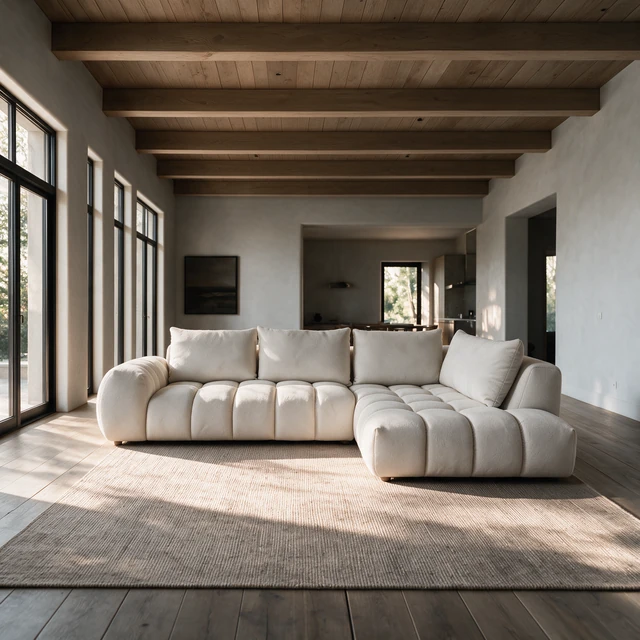
Two sofas facing each other: when and how to do it
Two facing sofas make a room for conversation. Here is when the layout works, the distances that make it comfortable and how to pair the two sofas.
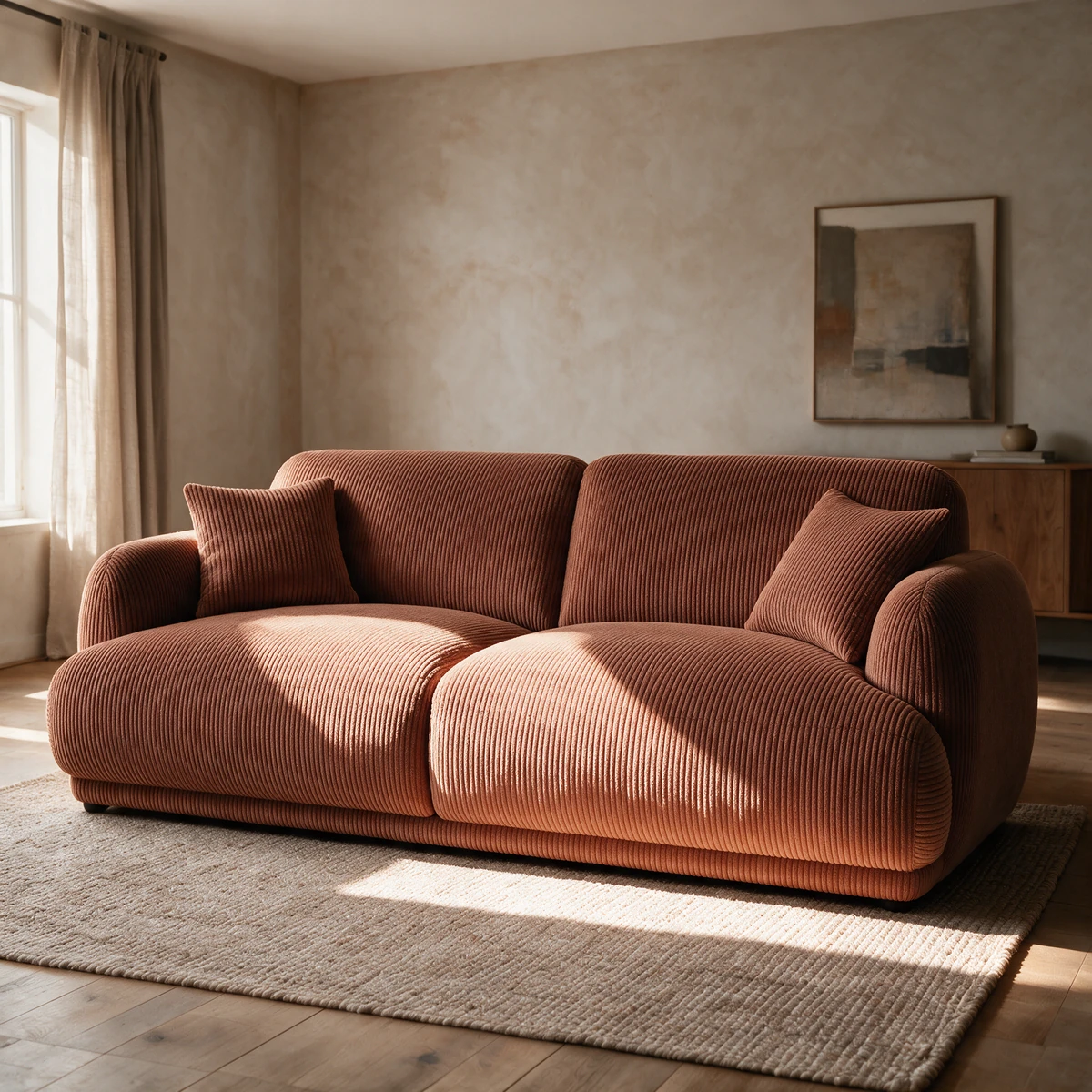
The short answer
Two sofas facing each other work best in a room meant for conversation and guests rather than TV, with about 1.5 to 2 m between the seat fronts: a coffee table in the middle and 40 to 50 cm on each side of it. That usually needs a room of about 3.5 m or more between the backs of the sofas. Choose two sofas of similar length, with seat heights within a few centimetres of each other, so everyone sits at the same eye level.
| Between the seat fronts | About 1.5 to 2 m |
|---|---|
| Seat to coffee table | 40 to 50 cm on each side |
| Room, back to back | About 3.5 m or more |
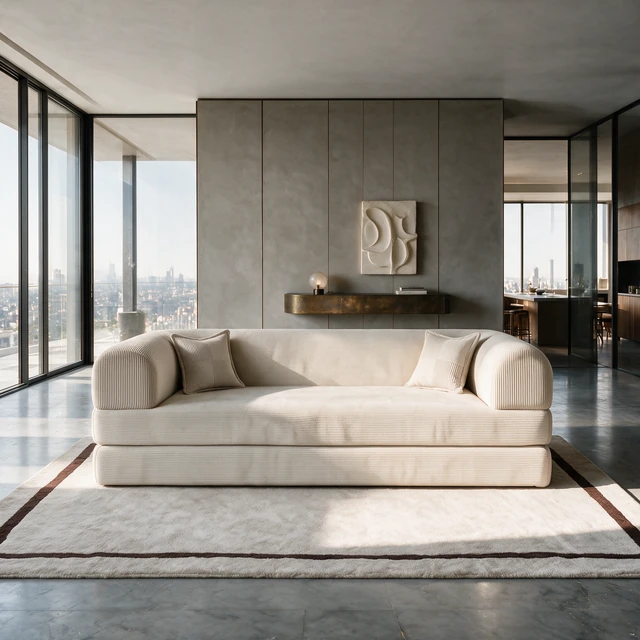
| Brioche 2-seater | 206 × 102 cm |
| Snoozo sofa bed | 190 × 90 cm |
In this guide
When two facing sofas are the right choice
Facing sofas turn a living room into a place for talking. Everyone sees everyone, nobody sits with their back to the room, and the coffee table in the middle becomes the centre of the evening. That makes the layout a natural fit for:
- a formal living room or a majlis, where guests are received;
- a large villa living room that needs a clear seating zone in the middle;
- a room with a focal point at one end, such as a big window, a feature wall or a piece of art;
- families who host often, for coffee after dinner or long evenings during Ramadan.
It also looks calm and balanced. Symmetry is restful to the eye, and a facing layout feels composed even when the room is full of people.
When another layout works better
- When the TV is the heart of the room. With facing sofas, the screen ends up at one end and everyone watches with their head turned. A sofa facing the TV wall, or a corner sofa, is kinder to a family that watches films together.
- When the room is narrow. Below about 3.4 m between the walls, the gap between the sofas gets tight, or the coffee table shrinks to almost nothing.
- When a main walkway would cut between them. People crossing between two facing sofas interrupt every conversation. Keep main routes at the open ends or behind the sofas.
Our guide to six living room layouts shows the alternatives, with the space each one needs.
How far apart should two facing sofas be?
Work from the coffee table outwards. Keep 40 to 50 cm between each seat front and the table, then add the depth of the table itself. A common rule is to keep facing seats within about 2.5 m of each other, so voices carry easily across the table.
| Coffee table depth | Gap between the seat fronts | Room needed, back to back, with two Brioches |
|---|---|---|
| 60 cm | 150 cm | 354 cm |
| 80 cm | 170 cm | 374 cm |
| 100 cm | 190 cm | 394 cm |
With other sofas, swap in their depth. The Snoozo is 90 cm deep, so two Snoozos with an 80 cm table need 350 cm from back to back. If either sofa stands away from the wall with a walkway behind it, add 75 to 90 cm on that side.
Two matching sofas, or two different ones?
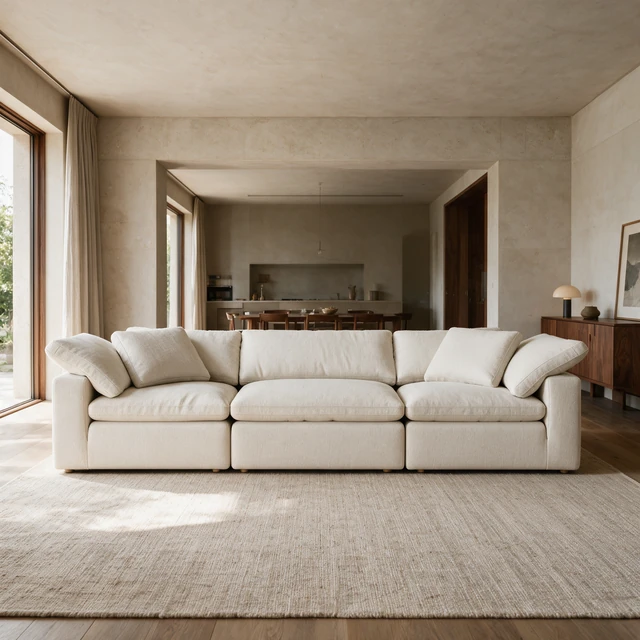
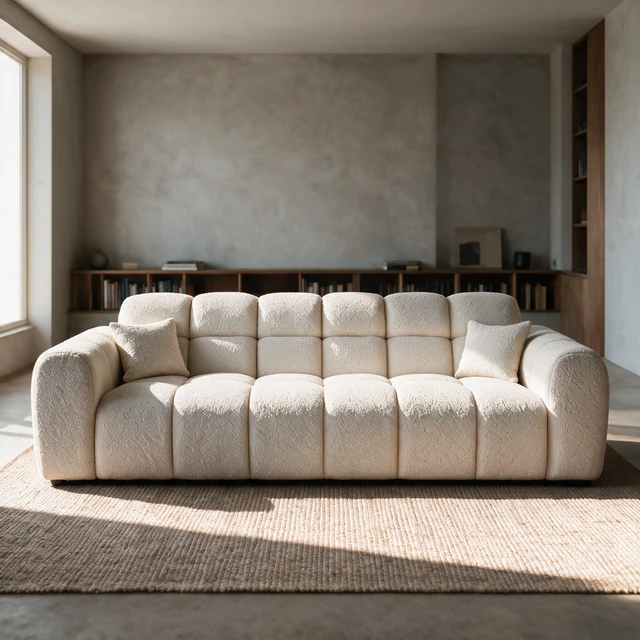
A matching pair is the simplest and most formal choice: same shape, same colour, perfect symmetry. Two Brioche 2-seaters facing each other make a cosy conversation corner even in an apartment, and two Nuage 3-seaters make a more generous, formal pair.
Mixing works well too, as long as the two sofas share three things:
- Seat heights within a few centimetres, so eyes meet at the same level. The Brioche (46 cm) and the modular Comfo (48 cm) are only 2 cm apart.
- A similar length, or a clearly intentional difference, such as a 3-seater facing a 2-seater with an armchair beside it.
- A common thread in fabric or colour. Brioche and Snoozo are both made in fine corduroy, in the same four colours, so a Brioche facing a Snoozo looks planned, whether in one colour or in two, such as Ecru and Terracotta.
Another option is a sofa facing two armchairs: it seats almost as many people and is easier to rearrange when the room changes.
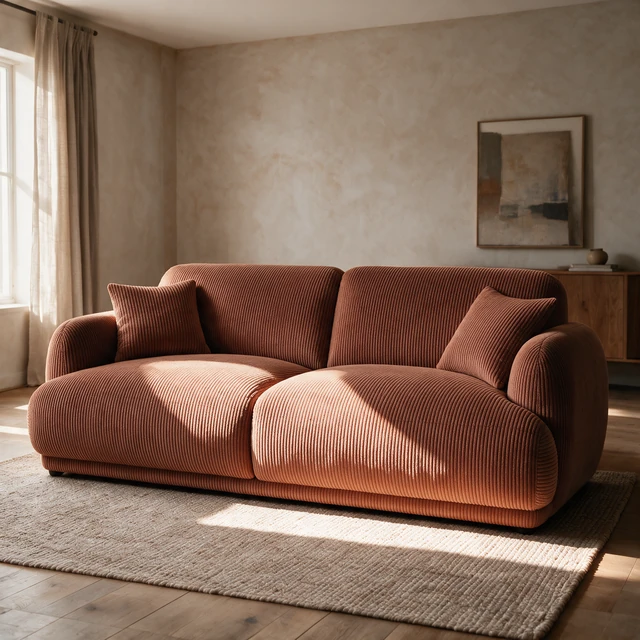
Two Brioche 2-seaters facing each other make a cosy conversation corner even in an apartment, and Brioche pairs naturally with Snoozo in the same fine corduroy and colours.
From AED 3,490 · delivered and installedWhat to do with the two open ends
Two facing sofas leave two open ends, and they decide how the arrangement feels. Usually one end stays open as the way in, so guests can walk in and sit down without stepping around furniture. Leave at least 60 cm there, and 75 to 90 cm if it is a main route.
The other end can be closed to make a U. Good options:
- a pair of armchairs, or a single armchair for the host;
- a console table with lamps, against the wall;
- a window, a feature wall or a piece of art as a focal point;
- the TV, if you want the room to switch between conversation and the occasional film.
Rug, coffee table and side tables
A rug pulls a facing layout together. The aim is to have at least the front of both sofas on it. With two Brioches and an 80 cm table, the seat fronts are 170 cm apart, so a 250 × 350 cm rug, laid with its long side along the sofas, reaches comfortably under both. Our rug size guide has the full chart.
For the coffee table, a long rectangle or oval works best, about two thirds the length of the sofas, so people at both ends can reach it. Add a side table at each outer end: in a layout made for long conversations, every seat needs somewhere to put a cup. The coffee table guide gives the heights and sizes.
Facing sofas in apartments and majlis rooms
In an apartment, two 2-seaters often fit where two 3-seaters cannot. Two Brioches at 206 cm each need about 354 cm between the walls with a 60 cm table, and they seat four comfortably, or six with two poufs at the open end.
In a majlis, facing sofas are a classic: guests face each other, the host serves along the open ends and side tables keep cups within reach. For bigger gatherings, two corner sofas facing each other also work; plan the chaises carefully, remembering that left and right are named as seen when you face each sofa. Our guide to arranging a majlis covers the layouts.
Before you order, check each wall with the Will it fit? tool on the sofa page: type the wall length and see the sofa drawn to scale, with the centimetres you have to spare.
Questions, answered
How far apart should two sofas facing each other be?
About 1.5 to 2 m between the seat fronts: 40 to 50 cm from each sofa to the coffee table, plus the depth of the table. Keep facing seats within about 2.5 m of each other so conversation stays easy.
Can two facing sofas be different models?
Yes. Keep the seat heights within a few centimetres, the lengths similar, and link them by fabric or colour. Two sofas in the same fabric family, such as two fine corduroy sofas, look planned even in different colours.
Do facing sofas work with a TV?
Only as a second use. With the TV at one open end, everyone watches with their head turned. If films are a big part of family life, choose a sofa facing the TV wall instead, and keep facing sofas for a formal living room or majlis.
What size rug for two sofas facing each other?
Usually 250 × 350 cm, laid with its long side along the sofas so the front of both rests on it. In a large room, 300 × 400 cm holds the whole arrangement.
Should facing sofas stand against the walls?
Not necessarily. In a large room, pull them in so the seat fronts are about 1.5 to 2 m apart, and leave 75 to 90 cm behind each one if people walk there. Pushed against walls that are far apart, the sofas end up too distant for easy conversation.