English
 العربية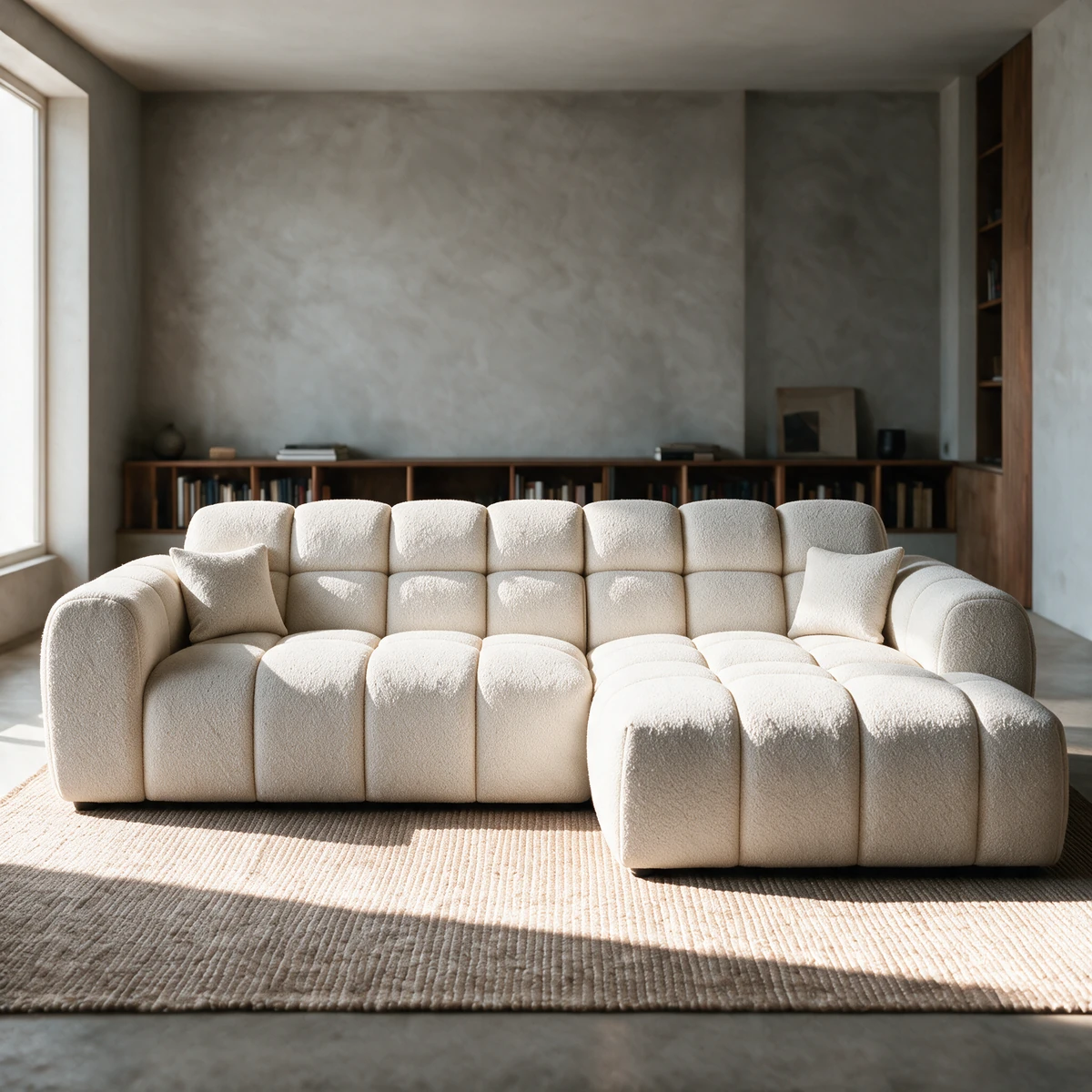
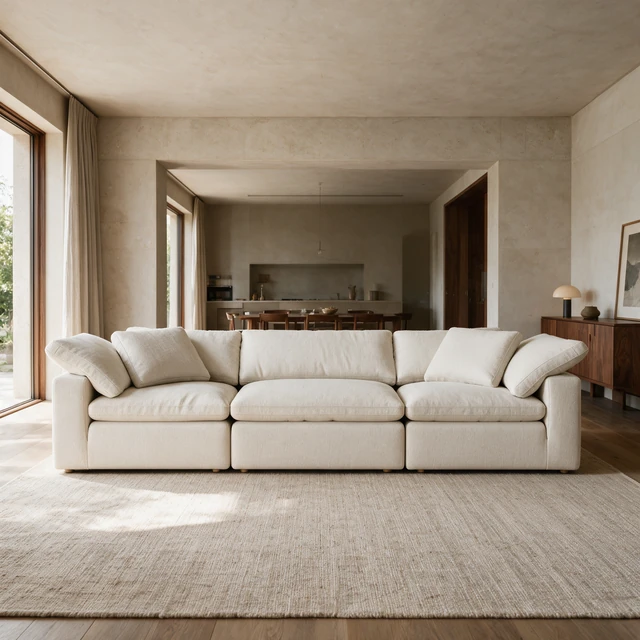
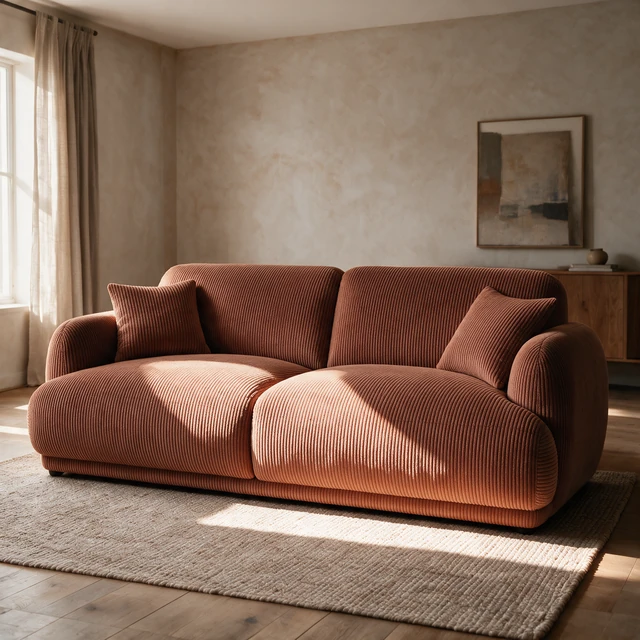
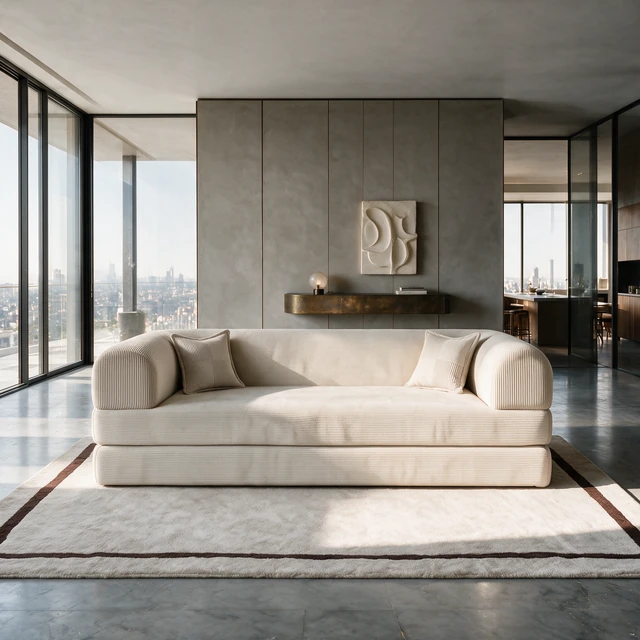
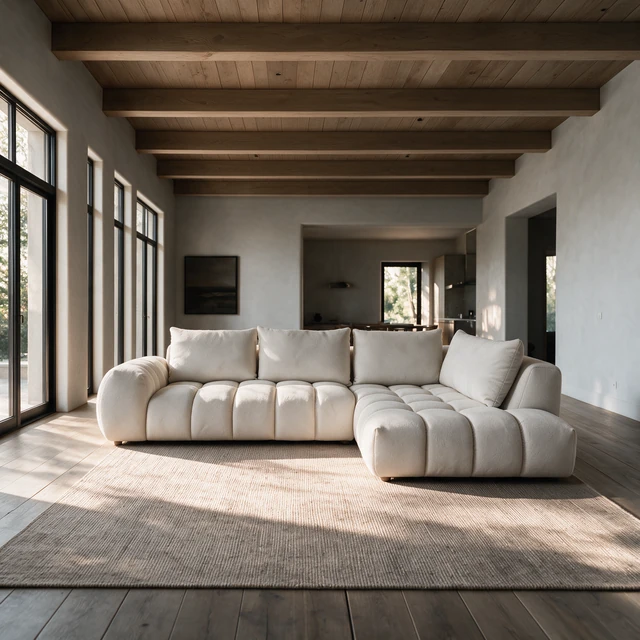
What size sofa for your living room? Wall, walkway and proportions
Three measurements tell you which sofa your room can take: the wall, the walkway and the depth. Here is how to take them and what the numbers mean.
The short answer
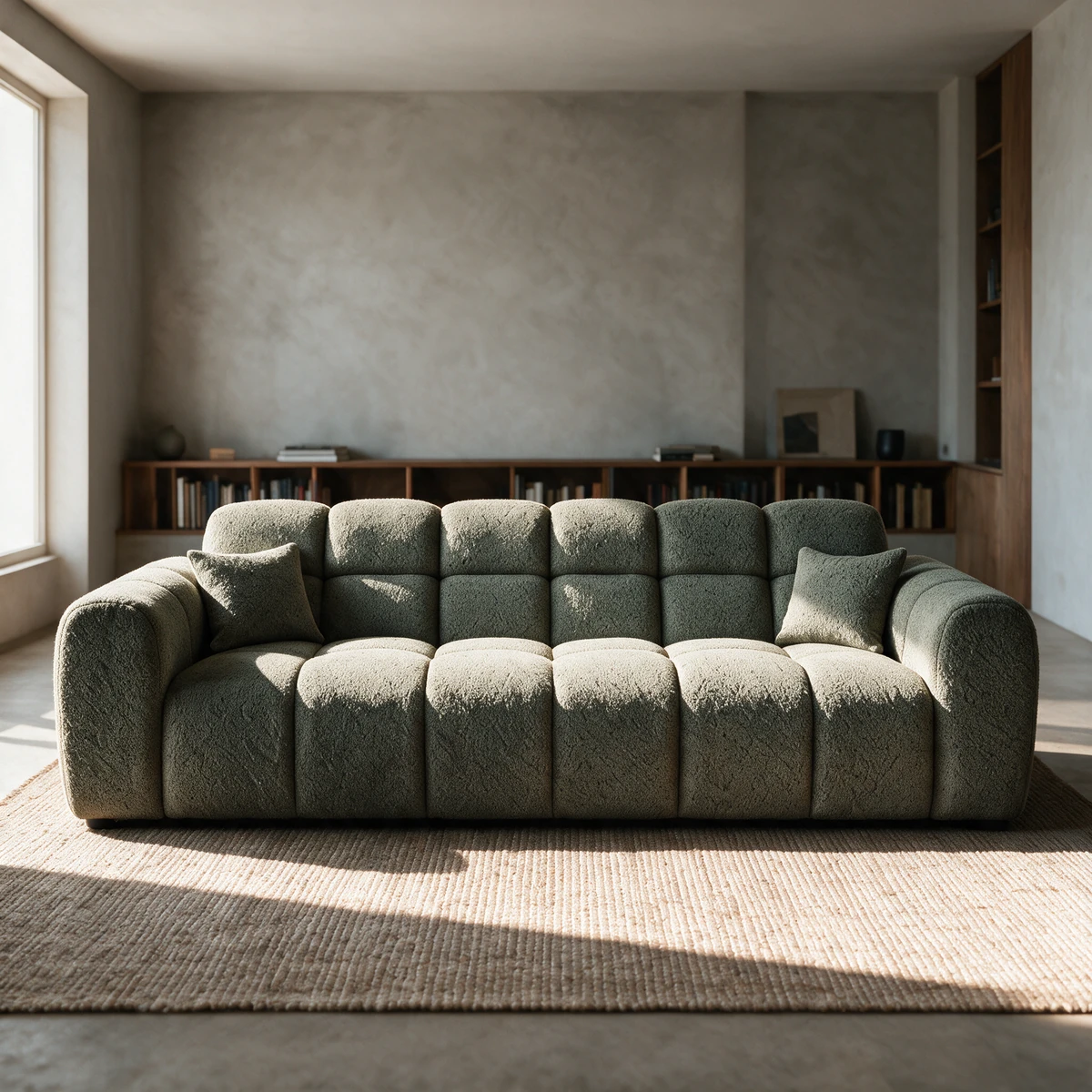
To work out what size sofa your living room needs, measure the wall it will stand against: a common design rule is that the sofa takes about two thirds of that wall, with at least 15 to 20 cm free at each end. Then check the depth, keeping about 60 cm to walk in front (75 to 90 cm on a main path) and 40 to 50 cm between the seat and the coffee table. On a 350 cm wall, two thirds is about 233 cm, which is right where the Nuage 3-seater sits at 230 cm.
| Sofa width | About two thirds of the wall |
|---|---|
| Free space at each end | At least 15 to 20 cm |
| Walkway in front | 60 cm, or 75 to 90 cm on a main path |
| Seat to coffee table | 40 to 50 cm |
| Nuage 3-seater | 230 × 95 cm |
In this guide
- How wide should a sofa be for your wall?
- What size sofa do I need for my room size?
- What to measure before you choose a sofa size
- How much space to leave around a sofa
- Is your room deep enough? The depth budget
- Proportions: height, depth and arms
- Which Pufflo sofa suits which wall?
- Check the size in your room before you order
How wide should a sofa be for your wall?
The simplest starting point is the two-thirds rule: the sofa takes up roughly two thirds of the wall behind it. Designers use this proportion because it leaves room at each end for a side table, a lamp or a plant, and it stops the sofa looking squeezed in. A sofa that runs wall to wall also makes cleaning harder, since dust and fine sand gather in the narrow gaps at each end.
Treat the rule as a range, not a law. Anything from a little under two thirds to about three quarters of the wall usually looks right. Much smaller, and a sofa can look lost on a long villa wall; much bigger, and the room starts to feel crowded. Whatever the proportion, keep at least 15 to 20 cm free at each end.
| Wall length | Two thirds | What usually suits it |
|---|---|---|
| 300 cm | About 200 cm | A 2-seater or a compact 3-seater |
| 350 cm | About 233 cm | A 3-seater |
| 400 cm | About 267 cm | A large 3-seater or a compact corner sofa |
| 450 cm | About 300 cm | A corner sofa |
| 500 cm or more | 333 cm or more | A large corner sofa, or a sofa with armchairs |
What size sofa do I need for my room size?
If you know the size of your living room rather than the exact wall, this table gives a first answer. It applies the two-thirds rule to the wall the sofa stands against, and names the shape that usually suits each room. Corner sofas use two walls, so they can run up to about three quarters of the longer one.
| Room size | Sofa width that usually suits it | Shape | Pufflo sofas to look at |
|---|---|---|---|
| 10 x 10 ft (about 3 x 3 m) | About 200 cm | A 2-seater or a compact 3-seater | Brioche, Snoozo |
| 12 x 12 ft (about 3.7 x 3.7 m) | About 240 cm | A 3-seater | Nuage 3-seater, Comfo 2-seater |
| 14 x 14 ft (about 4.3 x 4.3 m) | About 285 cm | A large 3-seater or a chaise sofa | Nuage with a chaise |
| 16 x 16 ft (about 4.9 x 4.9 m) | About 325 cm, or an L shape on two walls | A corner sofa | Doudou, Comfo corner or chaise |
| 18 x 20 ft (about 5.5 x 6 m) or more | About 400 cm, or a U shape on three sides | A large corner or a U shape | Comfo U-shape, Doudou |
The table is a starting point: doors, windows and walkways decide the final size, so measure as shown below. To count the seats your family needs, see how many seats you need; to weigh one shape against another, see 2-seater, 3-seater or corner sofa. And before you order, check that your sofa will fit through the lift and the door.
What to measure before you choose a sofa size
Three measurements tell you almost everything. Take them with a metal tape measure and write them on a quick sketch of the room.
- The wall. Measure the length the sofa can really use: from the corner to the edge of anything that interrupts it, such as a column, a window frame, a floor socket you need to reach or an air conditioning unit low on the wall.
- The depth. Measure from that wall to the opposite wall, or to the front of the TV unit. This decides how deep the sofa and the coffee table can be.
- The paths. Note where people walk: from the entrance of the room to the kitchen, the balcony or the bedrooms. A sofa should never sit across a route everyone uses.
Also check the height of any window sill behind the sofa. A sofa back that rises above the sill cuts into the window; a low back sits neatly below it and keeps the light.
How much space to leave around a sofa
Walkways are what make a room feel easy to live in. A common rule is to keep about 60 cm free wherever people pass now and then, and 75 to 90 cm on a main route, such as the way from the entrance to the kitchen. In family homes where children run through and guests arrive with trays of food or coffee, the wider figure is worth protecting.
In front of the sofa, the coffee table sits 40 to 50 cm from the edge of the seat: close enough to put down a cup without stretching, far enough for knees and feet. Our coffee table guide has the sizes and heights that go with it.
If the sofa stands against a wall, leave a gap of 5 to 10 cm behind it, so curtains hang freely and the back cushions do not rub the paint. If it floats in the room and people walk behind it, that gap becomes a walkway of 75 to 90 cm.
Is your room deep enough? The depth budget
Width gets all the attention, but depth is where many living rooms run out of space. Add up everything that lines up between the sofa wall and the opposite wall, and compare the total with your measurement. Here is a typical example with a 3-seater facing a TV.
| Item | Typical depth |
|---|---|
| Nuage 3-seater | 95 cm |
| Gap to the coffee table | 45 cm |
| Coffee table | 60 cm |
| Walkway | 75 cm |
| TV unit | 40 cm |
| Total | 315 cm |
If your room is shorter than the total, there are three easy fixes: a smaller or round coffee table, a wall-mounted TV instead of a unit, or a sofa with less overall depth.
For a corner sofa, check the second direction too. The chaise reaches into the room, so in that direction you need the chaise depth plus a walkway. For the Nuage corner, that is 152 cm plus 60 cm, or 212 cm, if people walk past the end of the chaise.
Proportions: height, depth and arms
Two sofas of the same width can feel very different in a room. Three details change their visual weight.
- Back height. A low back keeps sightlines open and makes a room feel larger. The Nuage stands 70 cm high, low enough to sit under most window sills. A taller back, like the Doudou at 85 cm, frames a large villa room and gives more support to your head.
- Depth. Deep seats are made for lounging and curling up, but they use floor space. Compare the overall depth with your depth budget, not only the seat.
- Arms. Wide arms look generous but take seat width. On the Nuage 3-seater, each arm is 28 cm, which leaves about 174 cm of seat between them.
In a big room, scale up rather than spread out: one generous corner sofa usually looks calmer than a small sofa surrounded by chairs. In a small room, choose fewer, larger pieces with clean lines and keep the floor around them clear. Our guide to 2-seater, 3-seater or corner sofas goes further.
Which Pufflo sofa suits which wall?
Here is how our five sofas line up against the two-thirds rule. The first wall length is where each sofa looks its best; the second is the shortest wall where it still fits with 30 cm to spare.
| Sofa | Width × depth | Looks best on a wall of about | Fits with room to spare from |
|---|---|---|---|
| Brioche 2-seater | 206 × 102 cm | 310 cm | 236 cm |
| Snoozo sofa bed | 190 × 90 cm | 290 cm | 220 cm |
| Nuage 3-seater | 230 × 95 cm | 350 cm | 260 cm |
| Nuage corner | 262 × 95 cm, chaise 152 cm | 390 cm | 292 cm |
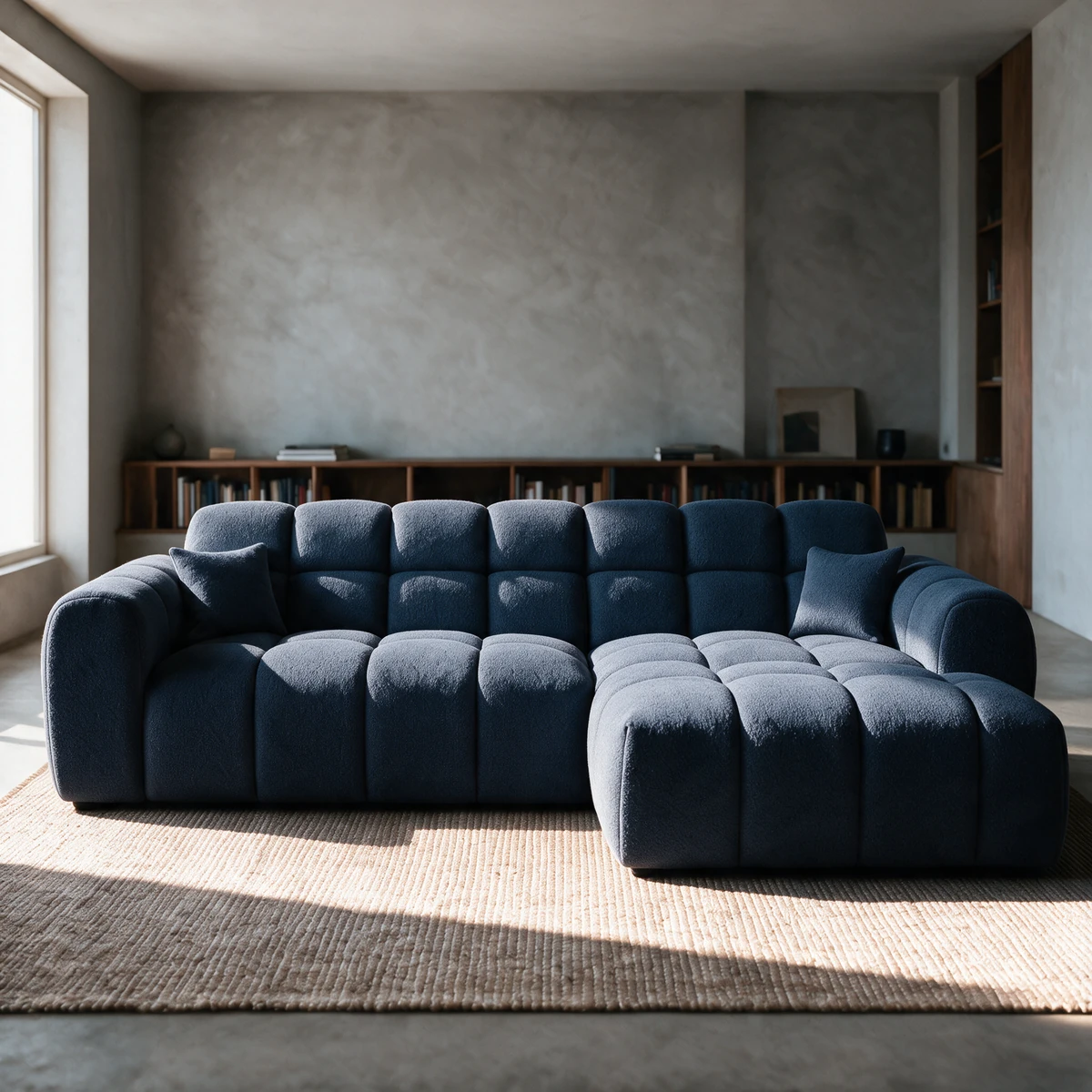
| Doudou corner | 352 × 100 cm, chaise 210 cm | 530 cm | 382 cm |
| Comfo 2-seater | 229 × 114 cm | 340 cm | 259 cm |
| Comfo 3-seater, chaise, corner or 5-module U-shape | 343 × 114 cm, or 229 cm deep with a chaise, a corner or a U | 510 cm | 373 cm |
| Comfo U-shape, 6 modules | 457 × 229 cm | 690 cm | 487 cm |
The Comfo is fully modular, so it appears three times: it comes as a 2-seater, a 3-seater, a chaise, a corner or a U-shape of 5 or 6 modules, and you can separate, join and rearrange the modules whenever your room changes.
To check your own wall, use the Will it fit? tool on each sofa page, for example on the Nuage: type the length of your wall and you see the wall and the sofa drawn to scale, with the centimetres you have to spare. If none of the standard sizes suits your room, you can ask for a custom sofa: the team replies within 48 hours with a drawing and a price.
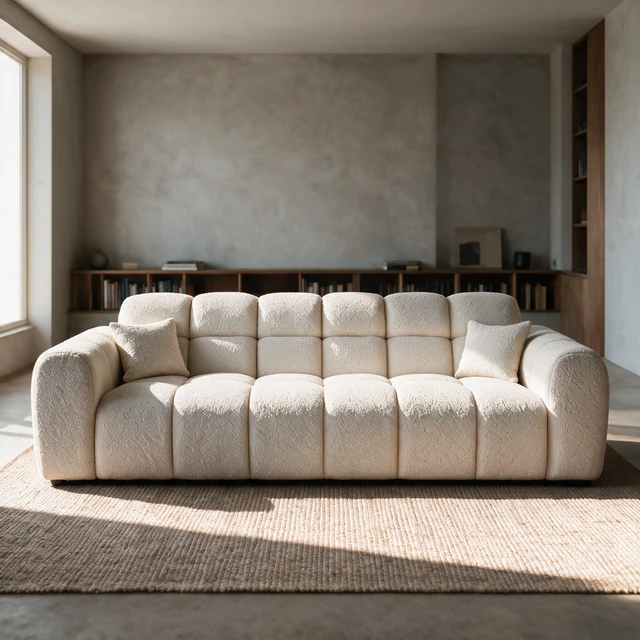
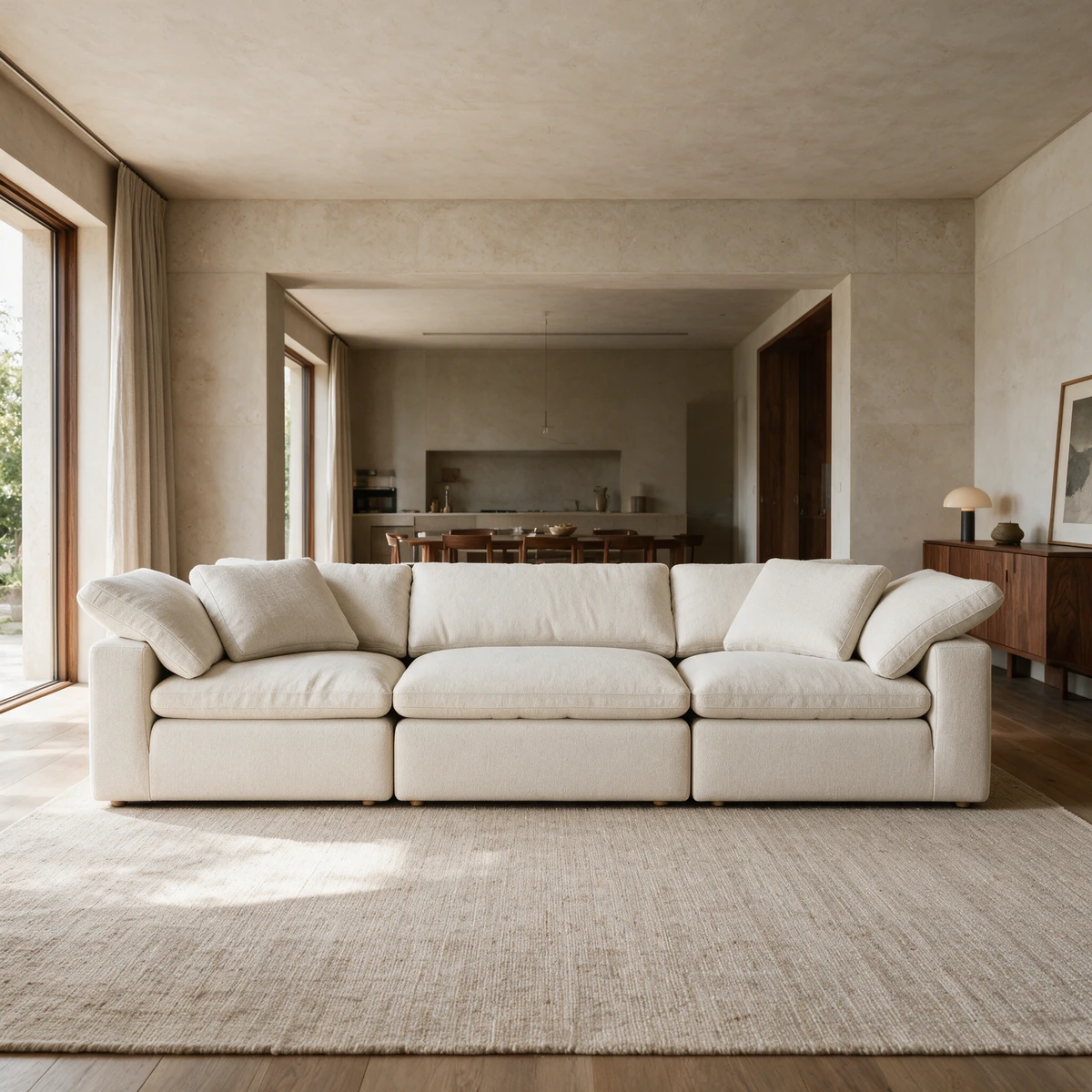
At 230 cm wide with a low 70 cm back, the Nuage 3-seater suits the most common living room walls, and it comes as a 262 cm corner when your wall is longer.
From AED 7,290 · delivered and installedCheck the size in your room before you order
Numbers on paper are one thing; standing next to the outline is another. Mark the sofa's full footprint on the floor with masking tape: width, depth and, for a corner sofa, the chaise. Add the coffee table if you have one in mind, then live with the outline for a day or two.
Walk your usual routes. Carry a tray past it. Sit on a dining chair placed at the tape line to see where your eyes land in relation to the TV or the view. If anything feels tight with tape, it will feel tighter once the sofa is there.
For a corner sofa, the tape also settles which side the chaise goes. Left and right are always named as seen when you face the sofa, not when you sit on it, and our guide to choosing a left or right chaise explains the simple rule that decides it.
Questions, answered
What size sofa fits a 3 metre wall?
Two thirds of 300 cm is about 200 cm, so a 2-seater of around 200 to 210 cm suits it best, such as the Brioche at 206 cm. A compact 3-seater can also work if you keep at least 15 to 20 cm free at each end. Type 300 cm into the Will it fit? tool on any sofa page to see it drawn to scale.
How far should a sofa be from the wall?
Against a wall, leave 5 to 10 cm so curtains hang freely and cushions do not rub the paint. If the sofa floats and people walk behind it, leave 75 to 90 cm. A gap in between, say 30 cm, is too narrow to walk through and mostly collects dust.
Can a sofa be too big for a room?
Yes. The signs are a walkway under 60 cm, a coffee table pushed closer than 40 cm to the seat, or a sofa covering more than about three quarters of its wall. A smaller sofa, or a corner sofa that uses an empty corner, often gives you the same seats with more space.
How deep should a sofa be for a small living room?
Look at the overall depth, not only the seat. Around 90 to 100 cm suits most living rooms, as long as your depth budget still leaves 60 cm to walk. The Snoozo is 90 cm deep, while the Brioche, at 102 cm, is generous for a 2-seater: very comfortable, but worth checking in a narrow room.
What if no standard sofa fits my wall?
Ask for a custom sofa. Send the length of your wall and the shape you have in mind, and the team replies within 48 hours with a drawing and a price. It is often the best answer for alcoves, very long villa walls and majlis rooms.