English
 العربية
Martindale, pilling and light fastness: how to read a fabric's grades
Three numbers say more about how a sofa fabric will age than its name. What each test measures, which grades to look for, and their limits.
The short answer
The Martindale rub test measures how many rubbing cycles a fabric survives before it shows wear; for a sofa used every day, a common rule is 25,000 cycles or more, and over 30,000 for families and pets. Pilling is graded from 1 (very severe) to 5 (none), and grade 4 or more is a good target. Light fastness is graded from 1 to 8, each step roughly doubling resistance to fading, and grade 6 or more suits sunny rooms with big windows.
| Martindale for daily use | 25,000 cycles or more |
|---|---|
| Martindale for families and pets | Over 30,000 cycles |
| Pilling (scale 1 to 5) | Grade 4 or more |
| Light fastness (scale 1 to 8) | Grade 6 or more for sunny rooms |
In this guide
What is the Martindale rub test?
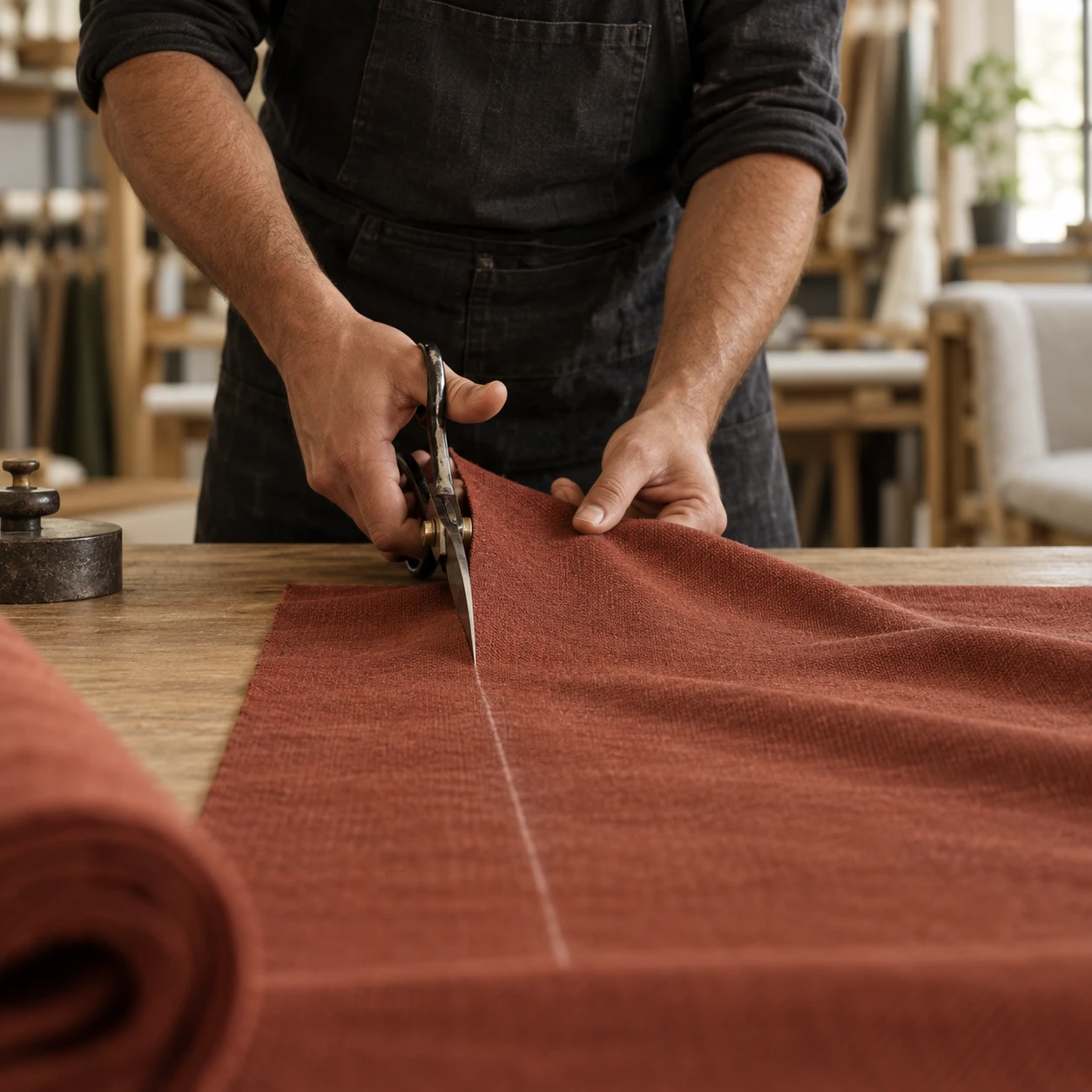
The Martindale test is the standard way to measure how well an upholstery fabric resists abrasion, set out in the international standard ISO 12947. A small round piece of the fabric is mounted in a machine and rubbed against a standard abrasive cloth, usually worsted wool, under a set weight. The movement traces a figure-of-eight pattern, so the fibres are rubbed from every direction, much like a body shifting on a seat.
Each full movement counts as one cycle, often called a rub. The machine is stopped at intervals to inspect the fabric, and the result is the number of cycles reached before it hits the end point, which for woven fabrics is usually two broken threads. A fabric rated at 30,000 Martindale survived around 30,000 cycles before reaching that point.
It is a lab test, so it does not translate into years of use. What it does well is compare fabrics with each other under the same conditions.
Martindale ratings: what the numbers mean for a sofa
There is no single official scale for homes, but the industry uses broadly similar bands. Treat them as a common rule rather than a law:
| Martindale cycles | Typical description | Good for |
|---|---|---|
| Under 10,000 | Decorative | Scatter cushions, headboards, curtains |
| 10,000 to 15,000 | Light domestic | Occasional chairs, guest rooms |
| 15,000 to 25,000 | General domestic | Sofas with moderate daily use |
| 25,000 to 30,000 | Heavy domestic | The main family sofa |
| Over 30,000 | Very heavy domestic and contract | Children, pets, busy majlis seating |
Commercial seating, in hotels or offices for instance, is often specified at 40,000 cycles or more. For a home sofa used every day by a family, over 30,000 Martindale cycles is a good benchmark.
What a Martindale number cannot tell you
A high number is reassuring, but it measures one thing only: resistance to flat rubbing. It says nothing about:
- Pilling, the little balls of fibre that form on the surface. A fabric can pass a very high Martindale count and still pill.
- Snagging from buckles, zips or toys, which depends on the weave and loop structure.
- Fading in the sun, which has its own test.
- Cleanability, which depends on the fibre and the cleaning code.
- Shading on pile fabrics such as corduroy and velvet, the soft glow that is part of their charm.
Beyond 40,000 to 50,000 cycles, extra numbers make little practical difference in a home; the frame, the foam and the other grades matter more. You may also see figures in double rubs, from the American Wyzenbeek test. It uses a different machine and motion, so there is no reliable conversion between the two. Compare like with like.
Pilling grades from 1 to 5
Pilling is tested by rubbing the fabric against itself or a standard fabric for a set number of cycles, either on a Martindale machine or in a rotating box, following ISO 12945. The result is compared with reference photographs under controlled light and given a grade:
| Grade | What you see |
|---|---|
| 5 | No pilling |
| 4 | Slight pilling |
| 3 | Moderate pilling |
| 2 | Distinct pilling |
| 1 | Very severe pilling |
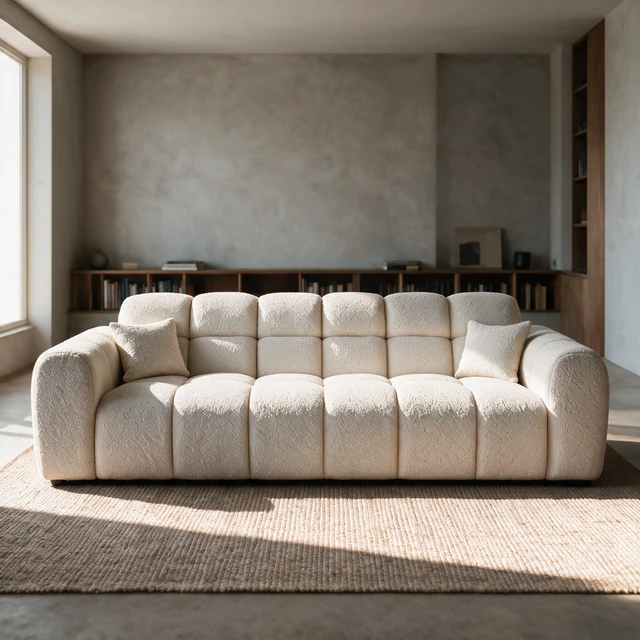
In-between results, such as 3.5, are common. For a sofa, look for grade 4 or more. On textured fabrics such as bouclé, a fabric shaver keeps the seat you use most smooth in seconds, whatever the grade. Our bouclé sofa guide explains how.
Light fastness grades from 1 to 8
Light fastness measures how well a fabric keeps its colour under light. In the test (ISO 105-B02), the fabric is exposed to a xenon arc lamp that imitates daylight through window glass, alongside eight blue wool reference cloths. Each reference fades at a known rate, and the fabric gets the grade of the reference that faded to the same degree.
The scale is not linear. Each grade needs roughly twice as much light to fade as the one below, so grade 6 resists about four times as much light as grade 4.
| Grade | Resistance | Suits |
|---|---|---|
| 1 to 3 | Poor to fair | Not recommended for upholstery in daylight |
| 4 | Moderate | Rooms without direct sun |
| 5 | Good | Most living rooms |
| 6 | Very good | Bright rooms with big windows |
| 7 to 8 | Excellent | Very sunny spots |
For UAE living rooms with large windows, look for grade 6. Placement still matters as much as the grade: see how to protect a sofa from the sun.
Other grades worth asking about
- Colour fastness to rubbing (ISO 105-X12): whether dye rubs off onto clothes or a white cloth, graded 1 to 5, dry and wet. It matters most for deep colours. Wet results are often a grade lower than dry ones.
- Seam slippage: how well the weave holds at the seams under strain, important on tightly filled cushions and on smooth, slippery yarns.
- Cleaning code: W, S, WS or X, telling you which cleaners the fabric accepts. It decides how easy everyday care will be.
- Composition: the fibres and their percentages. Synthetics such as polyester tend to resist abrasion and fading well; natural fibres such as cotton and linen feel soft and matt but crease and fade more easily.
A good fabric does well across the board rather than scoring one record number. A balanced set of grades is a better sign than a single headline figure.
A simple checklist to compare sofa fabrics
| Grade | Scale | Look for | Why it matters |
|---|---|---|---|
| Martindale | Cycles | Over 30,000 for family use | Resistance to everyday wear |
| Pilling | 1 to 5 | 4 or more | Seats stay smooth and neat |
| Light fastness | 1 to 8 | 6 or more near windows | Colour stays true in the sun |
| Rubbing fastness | 1 to 5 | 4 or more when dry | No dye on clothes or cushions |
| Cleaning code | W, S, WS, X | W or WS for families | Spills can be treated at home |
If a seller cannot give you these numbers, ask for them. Our fabrics page describes what each of our fabrics does best and how to care for it, and our guide to what makes a sofa last covers what to look for beneath the fabric of any sofa.
Questions, answered
Is 20,000 Martindale good for a sofa?
It is fine for a sofa with moderate use, such as a second living room or a calm adult home. For the main family sofa, used every day by children or pets, a common rule is at least 25,000 cycles and over 30,000 for peace of mind.
Is 100,000 Martindale better than 40,000?
In a lab, yes, but in a home the difference is small. Above 40,000 to 50,000 cycles, abrasion is rarely what ends a sofa's life; pilling, snags, fading, the frame and the foam matter more.
What does pilling grade 4 mean?
Grade 4 means slight pilling after the test, on a scale where 5 is none and 1 is very severe. It is a good result for upholstery, and any light pilling that does appear can be removed with a fabric shaver.
Can I compare Martindale with double rubs?
Not reliably. Double rubs come from the Wyzenbeek test, used mainly in North America, which works with a different machine and motion. Compare Martindale results with Martindale results, and double rubs with double rubs.
What light fastness do I need near a big window?
Look for grade 6 or more on the 1 to 8 blue wool scale. Even then, keeping the sofa out of direct afternoon sun and choosing a lighter colour will slow fading far more than any grade on its own.